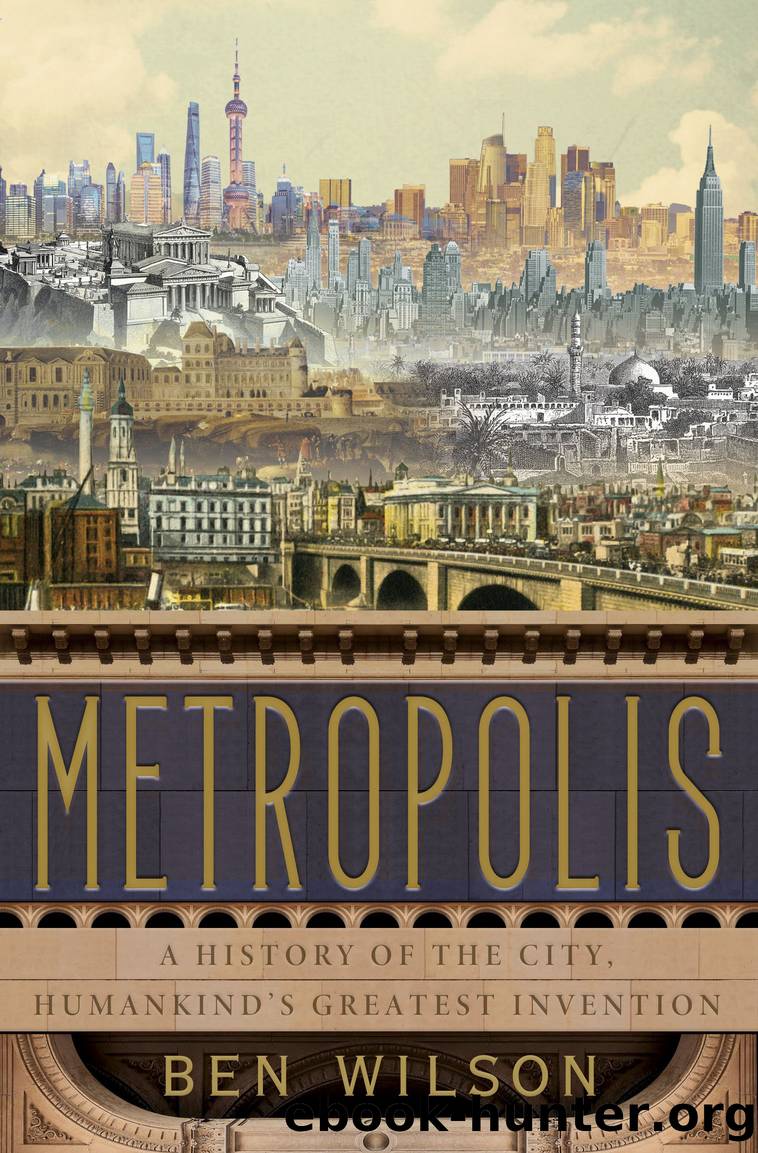
Metropolis by Ben Wilson
Author:Ben Wilson [Wilson, Ben]
Language: eng
Format: epub
Publisher: Knopf Doubleday Publishing Group
Published: 2020-11-10T00:00:00+00:00
âManchester is the chimney of the world,â wrote General Charles Napier in 1839. âRich rascals, poor rogues, drunken ragamuffins and prostitutes form the moral; soot made into paste by rain the physique; and the only view is a long chimney: what a place! the entrance to hell realised!â1
In the Manchester of the 1840s over 500 chimneys exhaled a thick blanket of coal smoke, powering new technologies of mass production. Alexis de Tocqueville marvelled in horror at Manchesterâs âhuge palaces of industryâ and the ânoise of furnaces, the whistle of steam.â Such a city had never been seen before. Every day the sound of thousands of power looms reverberated through it, shaking the buildings. The Swedish writer Fredrika Bremer captured the restless force of the industrial urban Frankenstein and its sensory impact: âManchester appeared to my eyes like a colossal spider, in the midst of its factories, towns, suburbs and villages, in which everything seemed to be spinningâspinningâspinning clothes for all the people in the world. There she sat, that Queen of spiders, surrounded by a mass of ugly houses and factories, veiled in a thick cloud of rain, not unlike a spiderâs web. It produced a dark, oppressive impression on me.â2
Bremer also visited Chicago. The American colossus, she wrote, was âone of the most miserable and ugly citiesâ in the world. It did not deserve the title âQueen of the Lake,â she commented acidly, âfor sitting there on the shore of the lake in wretched dishabille, she resembles rather a huckstress than a queen.â3
Like Manchester, Chicagoâs cityscape, with its ribbons of railroad tracks radiating from the city and tangle of telegraph lines, its monumental grain elevators and lumberyards, its noisome stockyards, steel mills and factory chimneys, was nineteenth-century industrialism made manifest. Visitors commented that Chicago sounded like no other city in the world, with the âdeep hollow roar of the locomotive and the shrill scream from the steamboatâ mingling with the clatter of industry, the squeals of thousands of hogs about to be slaughtered and the uproar of the incessant crowds. Others experienced the power of Chicago throbbing âwith an unbridled violence.â A French visitor felt the stench of Chicago grab him by the throat as soon as he arrived.4
Size, population growth and sensory assault were one thing. Much more daunting was what these new cities did to humanity. ManchesterââCottonopolisââstood at the heart of the global textile industry, ground zero in the history of worldwide industrialisation. The sight of Manchesterâs mills was a harbinger of humankindâs future: âHere humanity attains its most complete development and its most brutish,â wrote de Tocqueville, âhere civilisation makes its miracles, and civilised man is turned back almost into a savage.â5
On one side of the Atlantic, in the American South, slaves were mobilised to grow, harvest and pack cotton; on the other, an industrial workforce numbering in the hundreds of thousands was coerced to turn it into textiles. They were wage earners, dependent on the factory system. Women and children were favoured because they could
Download
This site does not store any files on its server. We only index and link to content provided by other sites. Please contact the content providers to delete copyright contents if any and email us, we'll remove relevant links or contents immediately.
| Africa | Americas |
| Arctic & Antarctica | Asia |
| Australia & Oceania | Europe |
| Middle East | Russia |
| United States | World |
| Ancient Civilizations | Military |
| Historical Study & Educational Resources |
The Dawn of Everything by David Graeber & David Wengrow(1705)
The Bomber Mafia by Malcolm Gladwell(1622)
Facing the Mountain by Daniel James Brown(1553)
Submerged Prehistory by Benjamin Jonathan; & Clive Bonsall & Catriona Pickard & Anders Fischer(1455)
Wandering in Strange Lands by Morgan Jerkins(1426)
Tip Top by Bill James(1414)
Driving While Brown: Sheriff Joe Arpaio Versus the Latino Resistance by Terry Greene Sterling & Jude Joffe-Block(1374)
Red Roulette : An Insider's Story of Wealth, Power, Corruption, and Vengeance in Today's China (9781982156176) by Shum Desmond(1359)
Evil Geniuses: The Unmaking of America: A Recent History by Kurt Andersen(1352)
The Way of Fire and Ice: The Living Tradition of Norse Paganism by Ryan Smith(1336)
American Kompromat by Craig Unger(1315)
F*cking History by The Captain(1302)
It Was All a Lie by Stuart Stevens;(1299)
American Dreams by Unknown(1285)
Treasure Islands: Tax Havens and the Men who Stole the World by Nicholas Shaxson(1272)
Evil Geniuses by Kurt Andersen(1257)
White House Inc. by Dan Alexander(1211)
The First Conspiracy by Brad Meltzer & Josh Mensch(1173)
The Fifteen Biggest Lies about the Economy: And Everything Else the Right Doesn't Want You to Know about Taxes, Jobs, and Corporate America by Joshua Holland(1125)
